
The Broadcast television system in the United States is an industry regulated by the Federal Communications Commission. Organizations are permitted to transmit video signals through the public airspace to antennas connected to viewer’s televisions. Anyone with a TV is allowed to watch the signal. Transmitting this signal is highly regulated and controlled. The only cost to the viewer is that of the viewing device and the burden of programming interruptions by commercial advertisements.
Due to the technical limitations of the electromagnetic spectrum through which the signals travel, there are a fixed number of transmission stations possible. The equipment required is expensive and difficult to configure and maintain. Towers, buildings, staff and massive amounts of electricity are needed to broadcast a signal. Who will pay for all this?
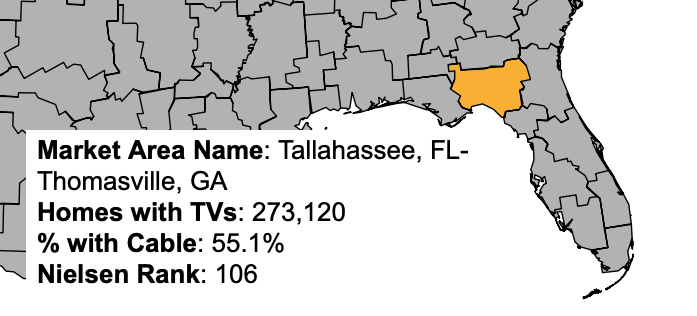
The United States is divided into 200+ geographic segments by Nielsen Media Research, a company that measures the audiences for a variety of mass media technologies. These are ranked in order of television viewers, with number 1 being New York City and number 210 being Glendive in eastern Montana (AdeptPlus, 2020). The number of viewers who watch your programming determines how much you can charge advertisers to show their ads.
The book states that “Broadcast television in the United States is based on the idea that programming should be available to all viewers and should be paid for through advertising.” (Hanson, 2019, p. 533). This may have been true in the 1960s and 1970s but is no longer accurate. Broadcast television in the United States is designed to generate revenue by maximizing advertising content and minimizing actual programming costs. Like the statement from the chapter on the internet, if it’s free to you, then you are the product. Broadcast television is a delivery system for paid ads.
In the mid 1990s I worked at WCTV, a Tallahassee CBS affiliate. I started with the entry-level job of Master Control Operator, which basically meant I was paid to watch TV and when it was time, play the ads. When I left three years later, I was directing the 5:30pm newscast and producing commercials. A lot has changed in the 20 years since I worked there, and it’s debatable if it’s good or bad.
Improvements in technology have allowed for increased productivity and new products and methods. The elimination of magnetic videotape has reduced the time it takes to do many production tasks. Multiple people can work with the same raw footage at the same time. Video can be sent across the country over the internet instead of with expensive satellite transmission or overnight mail. A box the size of three refrigerators that held 600 commercials is now the size of an iPod. Instead of a microwave or satellite truck for reporters on the scene, a reporter can send video with a backpack full of gear connected to the cellular network.

When I directed the news, we had a producer, director, graphics operator, sound engineer, two camera operators and a teleprompter operator. Now there is a director, sound engineer and one studio person who keeps an eye on the robotic cameras and runs the teleprompter. Reporters no longer have a camera person to assist in shooting video for stories. The reporter shoots the video themselves. As time passes, every technology advance seems to require less and less human intervention.
Program directors ride a very fine line. By showing something that gets high ratings, they can charge more for the ad segments during that show. But a show that is popular costs more for the station. The program director wants to keep costs low, so they gamble on lame shows. But they want people to watch in order to make ad dollars.

The news is just another show. By having a highly rated newscast you can charge more for ads. But that 30-minute news show costs way more than Jeopardy! That’s why they run the news multiple times. In addition to the 6:00pm news our parents watched we have 4:00pm, 4:30pm, 5:00pm, 5:30pm, 10:00pm on Fox, and finally 11:00pm. In major markets reporters may be working overnight, but in mid markets like Tallahassee 11:00pm stories run again the following morning.

Because television is a competition for viewers, the quality of news can vary. There is an old saying in the industry, if it bleeds, it leads! Someone was stabbed during a robbery. Did the victim die? If not, then the story probably won’t make the show. There can be a tendency to pander to the viewing tastes of the public and not necessarily to what the population needs to know. Will a reporter sit through a boring government meeting or go cover the building that burned down? If the building is still burning and will make good video, then the choice is already made.
Remember that DMA market system? Employee salaries trends along market size. Tallahassee is currently market 106. If a reporter wants to make money, they need to get a job in a better market, and that market has to be enough of a jump up so they can get out of their contract. How do you get a better job? By putting together a resume tape of high impact stories. News directors are going to spend two to three minutes reviewing the hundreds of applications they get for a reporter position. That YouTube link better have a fire, an explosion, a high-level politician getting caught in corruption or something that catches the eye. If not, on to the next candidate.
The result of this is that reporters aren’t interested in building relationships with sources and officials, they aren’t going to put in the time or effort to research the back story of an issue. The motivation is to get a sexy story that will look good on a resume. Besides, a news story is 45-90 seconds. There is no time for context.

Because television is an advertisement delivery system, there is a tendency to shy away from covering stories about advertisers. Some bigger markets have consumer reporters where they might confront a store or other service provider with camera rolling to help avenge a helpless viewer who got mistreated. Do you think that any of those stores, car dealerships, contractors or other vendors are going to be advertisers on that particular station? Not likely.
Are any advertisers going to have negative press? Not from the station that’s running the ad and not from the competition who is trying to get their business. That’s why you see more stories about local government. They don’t run ads. The reporter doesn’t care if they piss off a county commissioner because in six months to a year, they’re going to be on to the next town hundreds of miles away.
Television stations are competing with the internet for eyeballs, so every television company is now also a web company. Want up to the minute stories, weather or that sports score? Go to the station’s web site. Hey look! That banner ad is from the same car dealer that advertises during the news!
In the past, due to legal regulations and financial concerns, the majority of television stations were owned by independent companies or families. More and more television stations now belong to communications groups. Corporations own many stations in markets across the country. (Hanson, 2019). The only way to stay competitive is to try to lower costs. Can a local station develop their own web presence? Not at cheaply as a corporation that builds the same shell site for every affiliate they own to reuse. Just pop in a local story and the local car dealer’s ad. Your town’s football team is playing a game in another town. If the corporation is lucky it’ll be in a town where they own a station. One reporter creates a story and web article and both stations post it.
The increasing availability of fiber optic lines means further consolidation. A media company may own stations in five nearby towns. They can run the Master Control operations out of one building. A technician can now run commercials on five or more stations at once, meaning five less operators to pay. Those video servers can run that same episode of Jeopardy! on all five at the same time.

Like radio and satellite radio, things are moving toward the center. Markets show the same programs in every town. Just like there is a Home Depot and a McDonalds in every strip mall, TV stations show the same stuff. Because of the limited spectrum for broadcast, there isn’t the opportunity to narrowly focus and zero in on a target audience. The costs are so high that the ratings have to be just as high. Niche programming is on cable or the internet. Broadcast television is the center of the bell curve. Consolidation has reduced the variety and choice. This creates a disparity over what is available to different socioeconomic groups. Folks who can’t afford cable or satellite are left with whatever is broadcast over the air. Hopefully it’s something they want to watch.
Word Count = 1584

 cheerful