The Changing Television Industry

Written by drew on July 24th, 2020

The Broadcast television system in the United States is an industry regulated by the Federal Communications Commission. Organizations are permitted to transmit video signals through the public airspace to antennas connected to viewer’s televisions. Anyone with a TV is allowed to watch the signal. Transmitting this signal is highly regulated and controlled. The only cost to the viewer is that of the viewing device and the burden of programming interruptions by commercial advertisements. 

Due to the technical limitations of the electromagnetic spectrum through which the signals travel, there are a fixed number of transmission stations possible. The equipment required is expensive and difficult to configure and maintain. Towers, buildings, staff and massive amounts of electricity are needed to broadcast a signal. Who will pay for all this? 

The United States is divided into 200+ geographic segments by Nielsen Media Research, a company that measures the audiences for a variety of mass media technologies. These are ranked in order of television viewers, with number 1 being New York City and number 210 being Glendive in eastern Montana (AdeptPlus, 2020). The number of viewers who watch your programming determines how much you can charge advertisers to show their ads.
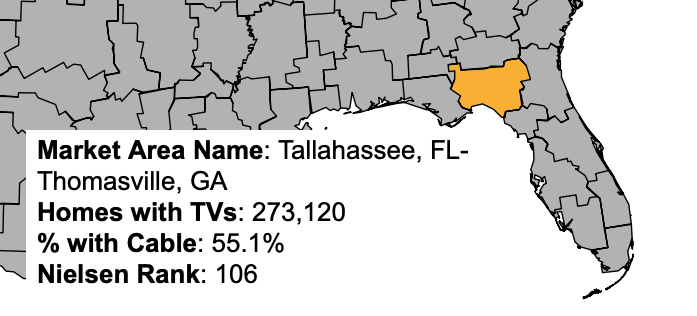
Think everyone has cable? Wrong! Forty-five percent don’t. (Zou, 2020)

The book states that “Broadcast television in the United States is based on the idea that programming should be available to all viewers and should be paid for through advertising.” (Hanson, 2019, p. 533). This may have been true in the 1960s and 1970s but is no longer accurate. Broadcast television in the United States is designed to generate revenue by maximizing advertising content and minimizing actual programming costs. Like the statement from the chapter on the internet, if it’s free to you, then you are the product. Broadcast television is a delivery system for paid ads.

In the mid 1990s I worked at WCTV, a Tallahassee CBS affiliate. I started with the entry-level job of Master Control Operator, which basically meant I was paid to watch TV and when it was time, play the ads. When I left three years later, I was directing the 5:30pm newscast and producing commercials. A lot has changed in the 20 years since I worked there, and it’s debatable if it’s good or bad.

Improvements in technology have allowed for increased productivity and new products and methods. The elimination of magnetic videotape has reduced the time it takes to do many production tasks. Multiple people can work with the same raw footage at the same time. Video can be sent across the country over the internet instead of with expensive satellite transmission or overnight mail. A box the size of three refrigerators that held 600 commercials is now the size of an iPod. Instead of a microwave or satellite truck for reporters on the scene, a reporter can send video with a backpack full of gear connected to the cellular network.

This reporter is lucky to have a videographer with her. Otherwise she’d be talking to a tripod. (Farewell Live Trucks, 2013)

When I directed the news, we had a producer, director, graphics operator, sound engineer, two camera operators and a teleprompter operator. Now there is a director, sound engineer and one studio person who keeps an eye on the robotic cameras and runs the teleprompter. Reporters no longer have a camera person to assist in shooting video for stories. The reporter shoots the video themselves. As time passes, every technology advance seems to require less and less human intervention. 

Program directors ride a very fine line. By showing something that gets high ratings, they can charge more for the ad segments during that show. But a show that is popular costs more for the station. The program director wants to keep costs low, so they gamble on lame shows. But they want people to watch in order to make ad dollars.

I hope you want to watch Jeopardy! Because it’s on at 7:30pm… (McCandless, 2020)

The news is just another show. By having a highly rated newscast you can charge more for ads. But that 30-minute news show costs way more than Jeopardy! That’s why they run the news multiple times. In addition to the 6:00pm news our parents watched we have 4:00pm, 4:30pm, 5:00pm, 5:30pm, 10:00pm on Fox, and finally 11:00pm. In major markets reporters may be working overnight, but in mid markets like Tallahassee 11:00pm stories run again the following morning.
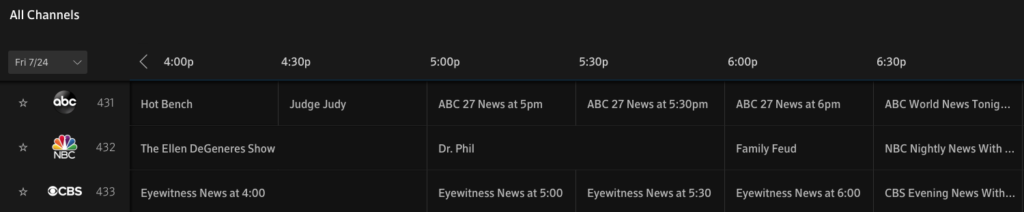
Eyewitness News! Now on 12 times a day! If you missed it, check it out online! Ugh.

Because television is a competition for viewers, the quality of news can vary. There is an old saying in the industry, if it bleeds, it leads! Someone was stabbed during a robbery. Did the victim die? If not, then the story probably won’t make the show. There can be a tendency to pander to the viewing tastes of the public and not necessarily to what the population needs to know. Will a reporter sit through a boring government meeting or go cover the building that burned down? If the building is still burning and will make good video, then the choice is already made. 

Remember that DMA market system? Employee salaries trends along market size. Tallahassee is currently market 106. If a reporter wants to make money, they need to get a job in a better market, and that market has to be enough of a jump up so they can get out of their contract. How do you get a better job? By putting together a resume tape of high impact stories. News directors are going to spend two to three minutes reviewing the hundreds of applications they get for a reporter position. That YouTube link better have a fire, an explosion, a high-level politician getting caught in corruption or something that catches the eye. If not, on to the next candidate. 

The result of this is that reporters aren’t interested in building relationships with sources and officials, they aren’t going to put in the time or effort to research the back story of an issue. The motivation is to get a sexy story that will look good on a resume. Besides, a news story is 45-90 seconds. There is no time for context. 

I hope my side is the right side of this station’s biggest advertisers… (2020)

Because television is an advertisement delivery system, there is a tendency to shy away from covering stories about advertisers. Some bigger markets have consumer reporters where they might confront a store or other service provider with camera rolling to help avenge a helpless viewer who got mistreated. Do you think that any of those stores, car dealerships, contractors or other vendors are going to be advertisers on that particular station? Not likely. 

Are any advertisers going to have negative press? Not from the station that’s running the ad and not from the competition who is trying to get their business. That’s why you see more stories about local government. They don’t run ads. The reporter doesn’t care if they piss off a county commissioner because in six months to a year, they’re going to be on to the next town hundreds of miles away.

Television stations are competing with the internet for eyeballs, so every television company is now also a web company. Want up to the minute stories, weather or that sports score? Go to the station’s web site. Hey look! That banner ad is from the same car dealer that advertises during the news! 

In the past, due to legal regulations and financial concerns, the majority of television stations were owned by independent companies or families. More and more television stations now belong to communications groups. Corporations own many stations in markets across the country. (Hanson, 2019). The only way to stay competitive is to try to lower costs. Can a local station develop their own web presence? Not at cheaply as a corporation that builds the same shell site for every affiliate they own to reuse. Just pop in a local story and the local car dealer’s ad. Your town’s football team is playing a game in another town. If the corporation is lucky it’ll be in a town where they own a station. One reporter creates a story and web article and both stations post it. 

The increasing availability of fiber optic lines means further consolidation. A media company may own stations in five nearby towns. They can run the Master Control operations out of one building. A technician can now run commercials on five or more stations at once, meaning five less operators to pay. Those video servers can run that same episode of Jeopardy! on all five at the same time.

Is this guy playing WoW or running 12 TV stations? (LiveCenter, 2016)

Like radio and satellite radio, things are moving toward the center. Markets show the same programs in every town. Just like there is a Home Depot and a McDonalds in every strip mall, TV stations show the same stuff. Because of the limited spectrum for broadcast, there isn’t the opportunity to narrowly focus and zero in on a target audience. The costs are so high that the ratings have to be just as high. Niche programming is on cable or the internet. Broadcast television is the center of the bell curve. Consolidation has reduced the variety and choice. This creates a disparity over what is available to different socioeconomic groups. Folks who can’t afford cable or satellite are left with whatever is broadcast over the air. Hopefully it’s something they want to watch.

Word Count = 1584
 

Derek Webb: Fingers Crossed

Written by jamie on October 1st, 2017

Derek Webb has been my favorite singer/songwriter for a lot of years. His newest album, Fingers Crossed, came out on Friday, and I was more than ready to hear it. I downloaded it first thing Friday morning and listened as I got ready for work. I caught snippets of powerful lyrics as I scrambled my eggs and dabbed on the minute amount of makeup I wear. I knew it was an album that I needed to sit down with and fully digest, so I made plans to do that over the weekend. I still listened through the album twice on Friday and was deeply moved, even as I was distracted by other things throughout my day.

Today I woke up to a gloomy, drizzly, overcast day. Perfect for music listening. I sat down and put everything else aside. I moved my phone away so it wouldn’t distract me. There were not lyrics available with the download, but luckily Derek has amazing diction. I curled up with some warm fleece socks on my feet and a blanket. My husband joined me on the couch and I was thankful for some company as we sat quietly together.

This album is an achingly beautiful piece of art from start to finish. Haunting melodies, gut-wrenching and honest lyrics, creative instrumentation, and those little vocal cracks that show Derek’s extreme vulnerability. One of the things I admire about Derek is the way he is willing to be completely and totally vulnerable in his music. And he does it with extreme passion.

The other thing I admire about Derek is that he is one of the few “Christian” artists that I still respect. Derek, a former member of the band Caedmon’s Call, was one of the musicians I listened to in heavy rotation back in my CCM-obsessed days. As I became weary and suspicious of the commercialism of CCM and manipulative lyrics of many Christian songs, I moved away from many of those musicians. Derek was the musician that continued to evolve; musically, stylistically, and spiritually. As I processed and became more angry at CCM culture, Derek’s music moved with me. His lyrics often echoed the frustrations I felt. I continued to follow him, impressed by his boldness to speak unpopular statements and the way the depth of his music continued to grow.

This latest album is a perfect example of that depth. It’s like he ripped his heart open and poured it directly onto the page while writing these songs. You can hear his pain, his struggle, his sliver of hope.

A few months ago, I started an online musician’s course (Middle Class Musician) hosted by Derek. I have loved gleaning his knowledge of songwriting, recording, and performing. One of the things that Derek said that has stuck with me is this: Don’t over explain your songs. “Let them populate it with their own emotional furniture.” As this new album made its way into the world, I’ve watched him do just that. Seeing the responses from others on social media has shown me that I’m not the only one deeply moved by these songs. And the fact that he has left enough room for us to see our own story is beautiful.

Since my struggle began with CCM, other pieces of my faith have been strained too. Bible reading, prayer, and definitely worship music were all once beautiful pieces of my story. Now they’re empty rituals that hold little meaning. As I listened to Fingers Crossed, I caught snippets of lyrics that made my heart ache from their honesty and the way I can relate to them all too well.

Cause something deep down in my heart

Something that made me who I was

Invisible

Oh, I guess it just didn’t pan out

Guess it’s just another heart I broke

A dream I woke up

-Tempest in a Tea Cup

The final song left me with tears literally streaming down my face and my husband pulling me into his arms. Through sniffles, I explained that I could see so much of my struggle in Derek’s lyrics that it was painful.

The reason it’s been so long since we talked

I’m not ready to show up

And feel nothing

I don’t even feel sad anymore

Just always looking for

Your replacement

….

So either you aren’t real

Or I am just not chosen

Maybe I’ll never know

Either way my heart is broken

So you left me here to document the slow unraveling

Of a man who burned the house down where he kept everything

And so I’ll say

Goodbye, for now

-Goodbye, For Now

I tweeted on Friday after my first listen to Fingers Crossed that I was already broken (in a really good way). I am particularly fond of music that makes my heart ache. (I guess it’s similar to the study where listening to sad songs can put you in a better mood.) For me, it’s having some of those deep personal struggles be put into beautiful, poetic words that help me to process them. It reminds me I’m not alone, and also gives me permission to cry. Because sometimes, I need a good cry to move through the tough stuff. I will add this album to the list of things to do when I need a good cry. It will be in the company of such things as an episode of This Is Us, or the Snape pensieve scene in Harry Potter & the Deathly Hallows Part 2.

I don’t always agree with every word on Derek’s albums, but I never cease to be touched by them. That’s the beauty of art. The words I do agree with are like a major punch in the gut. And, as every other Derek Webb album before, there’s an amazing depth that will take years and many listens to truly grasp. Each time I listen there’s another layer that I unearth. I am incredibly thankful for art like that and the artists that are brave and vulnerable enough to make it.


Whole30 – Final Thoughts

Written by jamie on May 30th, 2017

I made it. Day 30.

I wish I could say I feel amazing. I wish I could say my energy level is through the roof. But the truth is, I don’t, and it’s not.

Full disclosure: I’ve had a scratchy throat today which has gotten progressively worse. I feel like crap, and that is not the fault of Whole30, as much as I’d like to lay blame on it. (I’m grumpy and I want to blame all the things.) I am sick and that is likely why my energy level has been low the last few days of this challenge. It’s a very real possibility that I’ve been fighting this for a few days and that’s why I never got to “tiger blood.”

This article on tiger blood was helpful and showed me that maybe my expectations were too high. I was waiting for that “switch” when I started feeling focused, energized, and more stable (emotion wise). I never got there. At least not where I wanted to be. There were benefits and small victories, which I’ll share in a sec.

My plan on day 31 was to start slowly reintroducing foods to see if I had any reaction. I have a container of natural peanut butter in the fridge that has been calling my name all weekend. I am so ready for an apple smothered in peanut butter.

But now that I feel so crappy, I’m worried that if a certain food impacts me negatively I wouldn’t be able to tell. I could have a scoop of peanut butter and not know if I feel like crap from this sore throat or from the legumes. I hate to have done all this work and not find out if specific foods are treating me badly.

So I’m going to do a few extra days of Whole30. I’m going to wait to reintroduce foods until I start feeling better. It’s probably not a bad thing that I’ll be dosing up on fresh fruits and veggies while I’m sick. And who knows… maybe that tiger blood is waiting to rear it’s beautiful head.

To wrap up, I wanted to share my pros and cons of Whole30. I’ll start with the cons.

  • Time. SO MUCH TIME. Between meal planning, grocery shopping, cooking, and clean up, I feel like I spent about 80% of my month in the kitchen.
  • Expense. Eating healthy is expensive. I haven’t tallied up my total grocery budget for the month, but I know I went over my allotted amount.
  • Eating out. I HATE being that person at the restaurant who has to ask a million questions. Just flipping order. Who cares what oil they use to cook their eggs? Oh, apparently I have to care. And ask about it. And be annoying. Please don’t hate me, I promise I will tip well.
  • Cravings. I still want a damn COOKIE! Cravings were supposed to go away, but man, have I been craving a chocolate chip cookie.
  • Strict rules. Being so concerned about what oil things are cooked in, being absolutely paranoid that something might have soy or dairy or gluten… I’m over it.

Pros

  • Connection. I feel more connected with the food I’m eating. It’s refreshing to know what I’m eating, to know that it’s whole and healthy.
  • Cooking. As much as I kind of resented the time spent cooking, I also really enjoyed it. I love cooking from scratch but don’t do it enough. I had no choice to cook from scratch and really, it was fun. I like having my hands in all the prep and even making a mess.
  • Fun new foods. While Drew poked fun at some of the weird stuff I brought home, I definitely found some new foods that I will be incorporating into future meals. I’m looking at you, spaghetti squash.
  • Being intentional. I had no choice but to be intentional about my meals and plan ahead. That is a good thing for me. If I don’t plan ahead, I will grab a banana and granola bar and try to convince myself that’s enough for breakfast. Clearly it’s not, with how hungry I get all the time.
  • Cravings gone. Okay, I know I said cravings hadn’t gone away. Actually, some did. Not my sweet tooth apparently, but other foods. The one that really surprised me was cheese. Now I see shredded cheese and I think, “Nah, I’m good.” I’m sure I will still eat it in the future, but it’s good to know I can live without it.

So, Whole30 wasn’t as magical as I had hoped, but there were good things. I did find increased energy and focus on some days, just not consistently. But that’s okay. I have learned some valuable things about myself, my food consumption, and my food habits. And that is not a bad thing.

How do I plan to move forward? Assuming I don’t have any severe reaction to a particular food group, I intend to incorporate it all back into my diet. Bread, dairy, rice, pasta, sugar… bring it on. But I expect that my portion size will be different than it used to. Rather than a heaping pile of pasta and a small side of broccoli, I intend to reverse those proportions. I hope to keep the veggie consumption up and keep the other things in moderation. And I will probably still make zoodles on occasion, cause it’s kind of fun.

One more thought: this challenge made me think of another food challenge that Drew and I took part in several years ago. The Food Stamp Challenge. It is basically the exact opposite of Whole30. You purchase food with the monetary equivalent of what a family would get from food stamps. I remember eating crappy food and feeling undernourished. I remember feeling NOT GREAT. Although I may not have hit tiger blood on Whole30, I definitely never felt undernourished. And it makes my heart break that there are many people that cannot afford nourishing food.

I know that there are organizations in my community that help to provide families with food. I will be looking for ways that I can donate, beyond canned food drives. I know that money is the best way to donate, as that can used to provide things like fresh produce rather than canned green beans. I plan to start with Second Harvest. Do you know of any good local organizations that are working to combat hunger?


Whole30 – Day 30

Written by jamie on May 30th, 2017

I will share my final thoughts in another post. I felt like crap today because of a sore throat. More on that in the next post.

First, here’s my meal rundown for the day.

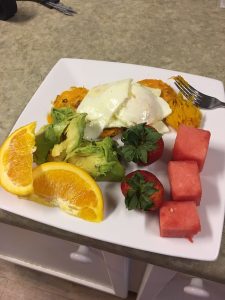
Breakfast: Three fried eggs, sweet potato toast (an entire sweet potato’s worth), a full avocado, watermelon, strawberries, and a couple slices of orange (I needed the vitamin C). I have been making an effort to up my protein and healthy fat intake to see if it fills me up for longer. I really don’t know how I could fit any more food on this plate. I admittedly could have included some green veggies, but I was feeling pretty out of it this morning and just didn’t think about it.


IMG_4083

I was full when I finished. Like really full. But then three hours later, I was hungry. I had a banana, which I really should have rounded out with some protein and maybe some veggies, but I was too tired to pack the “mini meal” that my snacks should consist of. I’ve tried to not snack, but I think I’m just one of those people with a fast metabolism and needs to eat a lot. Sorry. Go ahead and hate me.

Lunch: Chicken salad made with Whole30 mayo. Leftover broccoli slaw. Spinach. More orange slices. About a half cup of chicken broth (to help the sore throat). A handful of green olives. Again, I felt full, but was a tad hungry about two hours later. I had a pear, some almonds, and coconut flakes. I was a little more with it this afternoon and packed that mini meal.

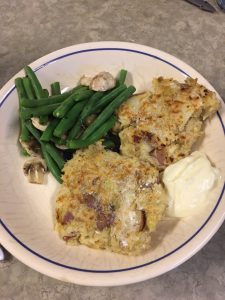
Dinner: This recipe was a pleasant surprise. We subbed tapioca flour for the flour to make it Whole30 compliant. I found salted cod on sale at Publix this week and decided to try it.
IMG_4081

I was buying smoked salmon and noticed it was BOGO. It was just cod and salt, so I decided to give it a try. It takes some prep, which I didn’t realize. It has to soak for 24 hours in water, and the water has to be changed several times. I regretted planning such a labor intensive meal on a day when I felt so crappy (especially when I realized we didn’t have enough potatoes and there was one egg left and I had to go to Publix). Fortunately, my wonderful hubby jumped in and cooked. And it turned out amazing.

IMG_4084